Choosing Your Knowledge Management Strategy
Knox Haggie, John Kingston, School of Informatics, University of Edinburgh
ABSTRACT:
In this paper, we survey a number of different knowledge management strategies and a range of driving forces for knowledge management activities. We synthesise these using an extended version of an existing “KM spectrum”; apply a knowledge engineering approach to provide further guidance for the KM spectrum; and then describe a simple classification approach that links the driving forces to KM strategies, using a number of published heuristics. Finally, a case study is presented in which we apply our approach and discuss its usefulness.
1. Introduction
Knowledge Management (KM) has been
the subject of much discussion over the past decade. Organisations are told
that they will not survive in the modern Knowledge Era unless they have a
strategy for managing and leveraging value from their intellectual assets, and
many KM lifecycles and strategies have been proposed. However, it has become
clear that the term "Knowledge Management" has been applied to a very
broad spectrum of activities designed to manage, exchange and create or enhance
intellectual assets within an organisation, and that there is no widespread
agreement on what KM actually is. IT applications that are termed
"knowledge management applications" range from the development of
highly codified help desk systems to the provision of video conferencing to
facilitate the exchange of ideas between people.
One fact that does seem to be agreed
on is that different situations require different knowledge management
strategies. But the range of different "Knowledge Management
Strategies" on offer can be bewildering and it is often unclear where to
begin in choosing a strategy for a particular situation. We will start by
examining a number of published KM strategies and consider how these can be
classified. We go on to consider a range of driving forces behind the
strategies, and then propose a strategy and a number of heuristics for the
selection of a suitable KM strategy.
First, though, we need a working
definition of what KM is. Many different definitions of KM have been published,
and several will be discussed in this paper. To avoid pre-empting the
discussion on the best definition of knowledge management in a given situation,
a very broad definition of KM is used for current purposes:
Knowledge Management can be thought
of as the deliberate design of processes, tools, structures, etc. with the
intent to increase, renew, share, or improve the use of knowledge represented
in any of the three elements [Structural, Human and Social] of intellectual
capital. (Seemann et
al, 1999)
In this section, we survey various
knowledge management strategies that have been proposed. The major difference
between the various approaches is that they emphasise different aspects of
knowledge management; some strategies focus on the knowledge, others on the
business processes/areas, and others on the end results.
2.1. Classification By Knowledge:
Nonaka & Takeuchi's Matrix Of Knowledge Types
While the best way to classify
knowledge is a matter of some debate (Beckman, 1999),
some of the most influential and helpful classifications of KM for
KM practitioners are based on a combination of knowledge accessibility
(i.e. where is the knowledge stored or located and in what form?) and knowledge
transformation (i.e. the flow of knowledge from one place to another and
from one form to another). This perspective underlies the analysis of Nonaka
& Takeuchi in their "knowledge spiral" (Nonaka & Takeuchi,
1995), as well as the "Information Space" ("I-Space") model
developed by Boisot (Boisot, 1998). Innovation or learning occurs as a result
of the flow and transformation of knowledge.
One of the most widely accepted and
widely quoted approaches to classifying knowledge from a KM perspective is the
“knowledge matrix” of Nonaka & Takeuchi. This matrix classifies knowledge
as either explicit or tacit, and either individual or collective.
Nonaka & Takeuchi also propose corresponding knowledge processes that
transform knowledge from one form to another: socialisation (from tacit
to tacit, whereby an individual acquires tacit knowledge directly from others
through shared experience, observation, imitation and so on); externalisation
(from tacit to explicit, through articulation of tacit knowledge into explicit
concepts); combination (from explicit to explicit, through a
systematisation of concepts drawing on different bodies of explicit knowledge);
and internalisation (from explicit to tacit, through a process of
"learning by doing" and through a verbalisation and documentation of
experiences).
Nonaka & Takeuchi model the
process of "organisational knowledge creation" as a spiral in which
knowledge is "amplified" through these four modes of knowledge
conversion. It is also considered that the knowledge becomes
"crystallized" within the organisation at higher levels moving from
the individual through the group to organisational and even
inter-organisational levels.
2.2. A
Second Knowledge Classification: Boisot's I-Space Model
Boisot (1998) proposes a model of knowledge asset development along
similar lines to that of Nonaka and Takeuchi. However, Boisot's model
introduces an extra dimension (abstraction, in the sense that knowledge
can become generalised to different situations). This produces a richer scheme
allowing the flow and transformation of knowledge to be analysed in greater
detail.
In Boisot's scheme, knowledge assets
can be located within a three dimensional space defined by axes from
"uncodified" to "codified", from "concrete" to
"abstract" and from "undiffused" to "diffused".
He then proposes a "Social Learning Cycle" (SLC) that uses the
I-Space to model the dynamic flow of knowledge through a series of six phases:
1. Scanning: insights are gained from generally available (diffused) data
2. Problem-Solving: problems are solved giving structure and
coherence to these insights (knowledge becomes 'codified')
3. Abstraction: the newly codified insights are generalised
to a wide range of situations (knowledge becomes more 'abstract')
4. Diffusion: the new insights are shared with a target population in a codified and
abstract form (knowledge becomes 'diffused')
5. Absorption: the newly codified insights are applied to a
variety of situations producing new learning experiences (knowledge is absorbed
and produces learnt behaviour and so becomes 'uncodified', or 'tacit')
6. Impacting: abstract knowledge becomes embedded in concrete practices, for example
in artefacts, rules or behaviour patterns (knowledge becomes 'concrete')
In his model, Boisot develops an
interesting application of the laws of thermodynamics in which knowledge assets
that are highly abstract, highly codified and undiffused, are seen to be the
most ordered and so have the lowest rate of entropy production and therefore
the maximum potential for performing value-adding work. Knowledge assets at the
opposite extreme of the I-Space (least abstract, least codified and most
diffused) have the highest level of entropy production and, therefore, have the
least potential for performing useful value-adding work. An organisation
pursuing competitive advantage is constantly seeking to move their knowledge
assets into the region of minimum entropy production and hence maximum value.
However, the dynamics of the SLC mean that they can never stay in this region,
but are constantly pulled away in a continual cycle of innovation and
application; trying to stem the lifecycle is fruitless, since knowledge must be
diffused to those who do not possess it in order to have any practical value.
This thermodynamic analogy points to
the elusive and dynamic nature of knowledge. It seems that what is happening is
a cycle in which data is filtered to produce meaningful information
and this information is then abstracted and codified to produce useful knowledge.
As the knowledge is applied in diverse situations it produces new experiences
in an uncodified form that produces the data for a new cycle of knowledge
creation.
What seems clear from both Boisot's
model and that of Nonaka & Takeuchi is that the process of growing and
developing knowledge assets within organisations is always changing.
Organisations are living organisms that must constantly adapt to their
environment. This means that the KM strategy identified as appropriate at one
moment in time will need to change as knowledge moves through the organisational
learning cycle to a new phase. The rate at which this cycle operates will vary
from one sector to another, so that in some rapidly evolving sectors new
knowledge is being created and applied in rapid succession, while in some more
established sectors, the cycle time of innovation is much slower.
2.3. Classification By Business
Process: APQC International Benchmarking Clearinghouse Study
Karl Wiig (1997) and the APQC
(American Productivity and Quality Center) identified six emerging KM
strategies in a study of organisations considered to be leading the way in this
area. The strategies reflect the different natures and strengths of the
organisations involved (Wiig, 1997; Manasco, 1996):
·
Knowledge
Strategy as Business Strategy
o A comprehensive, enterprise-wide approach to
KM, where frequently knowledge is seen as the product.
·
Intellectual
Asset Management Strategy
o Focuses on assets already within the company
that can be exploited more fully or enhanced.
·
Personal
Knowledge Asset Responsibility Strategy
o Encourage and support individual employees to
develop their skills and knowledge as well as to share their knowledge with
each other.
·
Knowledge
Creation Strategy
o Emphasises the innovation and creation of new
knowledge through R&D. Adopted by market leaders who shape the future
direction of their sector.
·
Knowledge
Transfer Strategy
o Transfer of knowledge and best practices in
order to improve operational quality and efficiency.
·
Customer-Focused
Knowledge Strategy
o Aims to understand customers and their needs
and so provide them with exactly what they want.
2.4. Another
Classification By Business Process: Mckinsey & Company
Day and Wendler of McKinsey &
Company, identified five knowledge strategies employed by large corporations, (Day & Wendler, 1998).
·
Developing and
Transferring Best Practices
o Like the "Knowledge Transfer
Strategy" identified by Wiig and the APQC above, this strategy focuses on
identifying best practices within an organisation and spreading them across a
dispersed network of locations.
·
Creating a new
industry from embedded knowledge
o This approach is to recognise that an
organisation may have knowledge which it can exploit in new ways. In
particular, it may have built up knowledge about its customers which reveals a
gap in the market for a new product.
·
Shaping
Corporate Strategy around knowledge
o This strategy was identified from the
experiences of Monsanto, which encompassed two very different business groups:
a chemicals group and a life sciences group. The chemicals group was focused on
best practice while the life sciences group was an innovation-based business.
The knowledge strategies for these two groups were perceived to be so different
that Monsanto decided to sell off the chemicals group and concentrate on the
life sciences business. This is an interesting example of the tensions between
two very different KM strategies.
·
Fostering and
Commercialising Innovation
o Similar to the Knowledge Creation Strategy
identified by Wiig and the APQC above, this strategy focuses on establishing a
competitive position by increased technological innovation and reduced time to
market.
·
Creating a
standard by releasing proprietary knowledge
o The example of Netscape is cited who
responded to the rapid decline of its market share in the internet browser market
by making its source code publicly available at no cost. The strategy is an
example of the "Intellectual Asset Management Strategy" identified by
Wiig and the APQC study. In this case, Netscape felt that it could capitalise
on a key asset (its source code) by giving it away. In return, it hopes to
establish its browser as a widely used standard (increased by the adaptation to
new specialty areas) and gain indirectly, by securing its share of a
complementary product, namely: server software.
2.5. Classification
By End Results: Treacy & Wiersema's Value Disciplines
Having examined a couple of studies
identifying various KM strategies being used, we now turn to two different
approaches which try to provide a business framework for choosing a KM
strategy. The first is based on an idea put forward by Michael Treacy and Fred
Wiersema which was taken up by Carla O'Dell and C. Jackson Grayson Jr. as a way
to provide focus to a KM effort (O'Dell &
Grayson, 1998).
Treacy and Wiersema proposed three
"value disciplines," as a way to focus an organisation's activities (Treacy & Wiersema, 1993). Successful
organisations concentrate their efforts on a particular area and excel at it,
rather than trying to be all things to all people and failing to excel at
anything.
·
Customer
Intimacy
·
Product
Leadership
·
Operational Excellence
These value disciplines reflect the
fact that 'value' is determined as a trade-off between convenience, quality and
price. It is the inherent tension between these three qualities of a product
that makes it necessary for an organisation to focus on excelling at just one
of them. There are a few organisations that have managed to become leaders in
two disciplines, but they have done this by focusing on one area first before
turning to a second one.
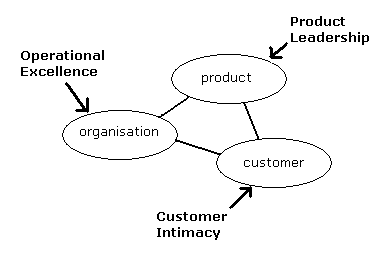
At a simplistic level, there are
three primary elements to any competitive business: the business itself, its
product(s) and its customers. Each of these components represents the focus of
attention for one of the value disciplines. The focus is on the customers and
their needs and desires when pursuing "Customer Intimacy"; the focus
is on the product(s) when pursuing "Product Leadership"; and the
focus is on the organisation itself and its delivery processes, when pursuing
"Operational Excellence".
Figure 1. Focus areas for Value Disciplines
Some organisations will concentrate
on their relationship with their customers (to increase customer satisfaction
and retention by better understanding the customer's needs and preferences).
Other organisations will focus on their products (constantly developing new
ideas and getting them to market quickly). The third group of organisations
focus primarily on themselves and their internal processes (sharing best
practices between different units, reducing costs and improving efficiency).
2.6. Linking
Knowledge And End Results: Zack's Knowledge Strategy
Another approach to identifying what
KM strategy to take is proposed by Michael Zack (Zack, 1999).
He proposes a framework which helps an organisation make an explicit connection
between its competitive situation and a knowledge management strategy to help
the organisation maintain or (re-)establish its competitive advantage. He makes
it clear that while each organisation will find its own unique link between knowledge
and strategy, any such competitive knowledge can be classified on a scale of
innovation relative to the rest of the particular industry as: core, advanced
or innovative:
·
Core knowledge
is a basic level of knowledge required by all members of a particular industry.
It does not represent a competitive advantage, but is simply the knowledge
needed to be able to function in that sector at all.
·
Advanced
knowledge gives an organisation a competitive edge. It is specific knowledge
that differentiates an organisation from its competitors, either by knowing
more than a competitor or by applying knowledge in different ways.
·
Innovative
knowledge is that which enables a company to be a market leader. It allows an
organisation to change the way a sector works and represents a significant
differentiating factor from other organisations.
Having identified the organisation's
competitive knowledge position, Zack's approach is to use a SWOT analysis
(Strengths, Weaknesses, Opportunities and Threats) to identify the strategic
gaps in an organisation's knowledge. This allows the organisation to identify
where it has knowledge which it can exploit and where it needs to develop
knowledge to maintain or grow its competitive position. This is achieved by
analysing the organisation's knowledge position along two dimensions:
·
Exploration vs.
Exploitation
This is
"the degree to which the organisation needs to increase its knowledge in a
particular area vs. the opportunity it may have to leverage existing but
under-exploited knowledge resources."
·
Internal vs.
External Knowledge
This refers
to whether the knowledge is primarily within the organisation or outside. Some
organisations are more externally-oriented, drawing on publications,
universities, consultants, customers, etc. Others are more internally-oriented,
building up unique knowledge and experience which is difficult for competitors
to imitate.
Putting these two dimensions
together, Zack describes organisations which are more exploitative of internal
knowledge as having a "Conservative" KM Strategy while those that are
more innovative (exploring external knowledge) have a more
"Aggressive" KM Strategy. However, he points out that a KM Strategy
cannot be made without reference to competitors. Thus, some industries (where
knowledge is changing more rapidly) tend to be characterised by more aggressive
firms, while other industries are generally more conservative.
3. A Synthesised Approach: Binney's KM Spectrum
Given that the classifications by
knowledge listed above (Nonaka & Takeuchi's knowledge matrix and Boisot’s
I-Space model) focus on the process of knowledge transformation, and that most
real world processes operate on a continuum rather than a step transformation,
it is perhaps not surprising to find that some researchers have suggested that
"explicit" and "tacit" knowledge should be considered to be
at the ends of a spectrum of knowledge types rather than being the only two
categories on that spectrum. Beckman (Beckman,
1999) has suggested that "implicit" knowledge is an
intermediate category of knowledge that is tacit in form, but is accessible
through querying and discussion. And Nickols (Nickols,
2000) proposes that Nonaka & Takeuchi's categories should be
further broken down according to whether they focus on declarative or
procedural knowledge.
What is needed is a classification
that proposes a spectrum of knowledge management approaches. If this spectrum
can accommodate the various approaches suggested in the previous section then
it can be considered to be sufficiently comprehensive to be useful. Derek
Binney (Binney, 2001) provides a framework, The
KM Spectrum, to help organisations make sense of the large diversity of
material appearing under the heading of KM, and to help them assess where they
are in KM terms. His focus is on the KM activities that are being carried out,
grouped into six categories:
1. Transactional KM: Knowledge is embedded in technology.
2. Analytical KM: Knowledge is derived from external data
sources, typically focussing on customer-related information.
3. Asset Management KM: Explicit management of knowledge assets
(often created as a by-product of the business) which can be reused in different
ways.
4. Process-based KM: The codification and improvement of business
practice and the sharing of these improved processes within the organisation.
5. Developmental KM: Building up the capabilities of the
organisation's knowledge workers through training and staff development.
6. Innovation/creation KM: Fostering an environment which promotes the
creation of new knowledge, for example through R & D and through forming
teams of people from different disciplines.
For each
of these categories of KM, Binney lists several examples of KM Systems or approaches
that support them—see Table 1.
Table 1. KM Spectrum and Applications (Binney, 2001)
|
Transactional |
Analytical |
Asset Management |
Process |
Develop- mental |
Innovation and Creation |
|
Case Based Reasoning (CBR) Help Desk Applications Customer Service Applications Order Entry Applications Service Agent Support Applications |
Data Warehousing Data Mining Business Intelligence Management Information Systems Decision Support Systems Customer Relationship Management
(CRM) Competitive Intelligence |
Intellectual Property Document Management Knowledge Valuation Knowledge Repositories Content Management |
TQM Benchmarking Best Practices Quality Management Business Process (Re) Engineering Process Automation Lessons Learned Methodology SIE/CMM, ISO9xxx, Six Sigma |
Skills Development Staff Competencies Learning Teaching Training |
Communities Collaboration Discussion Forums Networking Virtual Teams Research and Development Multi-Disciplined Teams |
Binney's analysis is interesting
because it reflects aspects of both the knowledge-centred classification of KM
and the business perspectives classification of KM. In terms of business perspectives,
Binney's categories reflect activities that support particular perspectives;
for example, "Asset Management KM" matches Wiig's "intellectual
asset management strategy", while "Innovation and Creation KM"
reflects Treacy & Wiersema's "product leadership" strategy. And
yet Binney's categories also form a progression from the management of explicit
knowledge at one end to tacit knowledge at the other. So, for example,
"Transactional KM" involves codifying knowledge and embedding it in
applications such as Help Desk Systems or Case Based Reasoning systems, while
"Innovation and Creation KM" focuses on facilitating knowledge
workers sharing and creating new knowledge which rests in a tacit form in their
heads. See Table 2 for a proposed
mapping of Binney's categories to other classifications.
Table 2. KM Spectrum mapped to other KM
Classifications
|
KM Spectrum |
Transact-ional |
Analytical |
Asset Management |
Process |
Develop-mental |
Innovation & Creation |
|
K. Accessibility: |
explicit |
implicit |
tacit |
|||
|
K. Conversion: |
combination |
externalisation |
internalisation |
socialisation |
||
|
SLC (Boisot) |
Problem Solving |
Scanning / Abstraction |
Impacting |
Diffusion |
Absorption |
|
|
K. Type |
Mostly procedural |
Mostly declarative |
Declarative |
Procedural |
Either |
Either |
|
Value Disciplines (Treacy &
Wiersema, O'Dell & Grayson, Section 2.4) |
Operational Excellence |
Customer Intimacy |
Any |
Operational Excellence |
Any |
Product Leadership |
|
KM Strategies (Wiig/APQC, Section 2.2) |
Knowledge Transfer |
Customer-Focused Knowledge |
Intellectual Asset Management |
Knowledge Transfer |
Personal Knowledge Asset
Responsibility |
Knowledge Creation |
|
KM Strategies (Day & Wendler, Section 2.3) |
Developing and transferring best
practices |
Creating a new industry from
embedded knowledge |
Creating a standard by releasing
proprietary knowledge |
Developing and transferring best
practices |
Transferring best practices |
Fostering and commercialising
innovation |
|
K. Strategy type (Zack, Section 2.5) |
conservative (exploiting existing
knowledge) |
aggressive (creating new
knowledge) |
||||
For each element of the spectrum,
Binney also lists a set of enabling technologies used to implement those kinds
of KM Applications. This provides an alternative way to identify KM activity
already being undertaken within an organisation, even if not previously
perceived in KM terms. This mapping is reproduced in Table 3.
Table 3. Enabling technologies mapped to the
KM Spectrum (Binney, 2001)
|
Transactional |
Analytical |
Asset Management |
Process |
Develop- mental |
Innovation & Creation |
|
Expert Systems Cognitive Technologies Semantic Networks Rule-based Expert Systems Probability Networks Rule Induction Decision Trees Geospatial Information Systems |
Intelligent Agents Web Crawlers Relational and Object DBMS Neural Computing Push Technologies Data Analysis and Reporting Tools |
Document Management Tools Search Engines Knowledge Maps Library Systems |
Workflow Management Process Modelling Tools |
Computer-based Training Online Training |
Groupware e-Mail Chat Rooms Video Conferencing Search Engines Voice Mail Bulletin Boards Push Technologies Simulation Technologies |
4. Discussion Of The KM Spectrum
This "knowledge management
spectrum" has a number of implications for the way that knowledge
management is done, and even for the definition of what knowledge management
is. Binney makes a number of observations about the spectrum, which are used in
this article as starting points for discussion.
4.1. Features Of The Spectrum
Several features that differentiate
knowledge management approaches can be observed from this spectrum. We can see
how the different approaches have different specialisations; for example, there
is a left-to-right transition from techniques that are good for managing
explicit knowledge to techniques that are good for managing tacit knowledge,
with techniques for managing Beckman's category of implicit knowledge falling
in the middle of the spectrum. There are several other transitions, too: the
degree of individual choice (for the user of the managed knowledge) increases
from left to right; the choice of tools or approaches for carrying out a
knowledge based task increases from left to right; and the emphasis on the need
for organisational change also increases from left to right.
It's clear that what is referred to
as "Knowledge management" actually consists of a range of techniques
that address different organisational issues and needs. Indeed, Binney notes
that "there appears to be an author affinity to parts of the spectrum
depending on each author's discipline and background. Management theorists tend
to be primarily focused on the process, innovation/creation and developmental
elements of the spectrum, with technologists focusing more on the
transactional, analytical and asset management elements". The implications
of this observation reach to the foundations of knowledge management, for it
helps explain disagreements over the definition of knowledge management:
technologists tend to explain knowledge management in terms of externalisation
or combination of knowledge, while management theorists generally focus on
knowledge management as a process of socialisation and internalisation. This in
turn leads to different opinions of approaches and techniques for knowledge
management, notably the use of technology; management theorists tend to think
of technology as being merely an enabling factor to socialisation and
communication, while technologists see it as the central focus. For example,
Scarbrough and Swan (Scarbrough & Swan, 1999)
collect some case studies which seem to suggest that many KM initiatives
over-emphasise the role of IT systems with a resulting failure to address human
factors adequately.
These two views of knowledge
management can be characterised as the "cognitive" view and the
"community" view. The community view emphasises knowledge as socially
constructed and is managed primarily by encouraging groups and individuals to
communicate and share experiences and ideas. The cognitive view regards
knowledge in objective terms which can be expressed and codified, and is often
expressed by the capture and codification of knowledge in computer systems.
However as Binney points out, if
Nonaka & Takeuchi's knowledge spiral is accepted, then the organisation
must be managing both explicit and tacit knowledge at all times in some way, in
order for the knowledge spiral to keep flowing. This view is supported by
Hansen and colleagues (Hansen et al,1999), who
suggest that most organisations should operate with a mixture of an explicit
codified knowledge strategy and a highly creative and customised strategy, but
not in equal proportions. So it would seem that Binney's spectrum does identify
different techniques that are applicable for different types of knowledge
management, but that most organisations will be using two or more of these
techniques, incorporating both a "cognitive" and a
"community" approach, if their knowledge is continuing to grow or improve.
4.2. Completeness Of The KM Spectrum
It's worth considering whether the
KM spectrum deals with all known approaches to knowledge management, and if
not, to consider why. Two approaches that are not covered have been identified,
and these are discussed in turn.
4.2.1. Knowledge Management As A Corporate Strategy
One of the knowledge management
approaches identified by Day & Wendler was "Shaping corporate strategy
around knowledge"; Wiig has a similar category of "Knowledge Strategy
as Business Strategy". Day & Wendler's example was of Monsanto, who
found that its two divisions used such different approaches to knowledge
management that they decided to sell off one of the divisions. This approach
would not be expected to be incorporated into Binney's KM spectrum, for it does
not map to a single approach in the spectrum; rather, it is a decision made as
a result of the type of analysis that the KM spectrum provides.
4.2.2. Asset Improvement
From a technologist's point of view,
there is one area of knowledge-related technology that does not appear in the
spectrum: the area of improvement of existing knowledge assets through
optimisation techniques. This does appear to be an omission from the spectrum,
for the optimisation of knowledge assets is aimed at increasing their utility,
and so should qualify as "knowledge management". Since asset
improvement is normally done using computer-based statistical techniques, but
does not transform the asset into a different form, it belongs to the left of
Asset Management but to the right of Analytical KM in the spectrum.
On the basis of this, we suggest a
revised version of the KM spectrum (Table 4).
We also suggest revisions to Table 2
and Table 3, which are presented below.
Table 4. Revised KM Spectrum and Applications
|
Transac-tional |
Analytical |
Asset Improve-ment |
Asset Manage-ment |
Process |
Develop- mental |
Innovation and Creation |
|
Case Based Reasoning (CBR) Help Desk Applications Customer Service Applications Order Entry Applications Service Agent Support Applications |
Data Warehousing Data Mining Business Intelligence Management Information Systems Decision Support Systems Customer Relationship Management
(CRM) Competitive Intelligence |
Timetabling Job shop scheduling Configuring layouts Time & Motion studies Supply chain management Allocation of resources |
Intellectual Property Document Management Knowledge Valuation Knowledge Repositories Content Management |
TQM Benchmarking Best Practices Quality Management Business Process (Re) Engineering Process Automation Lessons Learned Methodology SIE/CMM, ISO9xxx, Six Sigma |
Skills Development Staff Competencies Learning Teaching Training |
Communities Collabor-ation Discussion Forums Networking Virtual Teams Research and Development Multi-Disciplined Teams |
The technologies that might be used
for Asset Improvement include:
·
Linear
Programming
·
Genetic Algorithms
·
Ant colony
programming
·
Operational
Research techniques
And the classifications of Asset
Improvement against the knowledge management perspectives of Table 2 would be:
·
Knowledge
Accessibility: Explicit
·
Knowledge
Conversion: Combination
·
Knowledge Type:
Mostly procedural
·
Value
disciplines: Operational excellence
·
KM strategies
(Wiig): Intellectual asset management
·
KM strategies
(Day & Wendler): Developing best practices
·
KM strategy
type (Zack): Conservative
4.3. A Knowledge Engineering
Approach To The KM Spectrum
A popular approach to knowledge
engineering is the very detailed CommonKADS methodology (Schreiber et al, 2000). One of its most
widely admired aspects is its classification of knowledge based tasks into
knowledge types; a range of knowledge based task types are proposed
(classification, diagnosis, assessment, configuration, planning, etc.),
generally classified under "analytic" tasks (analysis of an existing
situation or artefact) and "synthetic" tasks (generation of a new
situation or artefact).
CommonKADS' approach is admired not
just because of the classification, but also because of the library of generic
inference models that are associated with each task type. However, for current
purposes, it is the classification of task types that is of most interest. This
classification can be applied to the KM spectrum directly, and at a meta-level:
·
Do these task
types map to the KM spectrum, or to other reviewed KM approaches, in any way?
·
What is the
type of the task of selecting an appropriate approach from the KM spectrum, and
of creating the KM spectrum itself?
4.3.1. Mapping Commonkads Task Types To The KM Spectrum
There is not a complete one-to-one
mapping between CommonKADS' task types and the KM spectrum, because the KM
spectrum represents strategic approaches rather than specific problem-solving
techniques. However, partial mappings do exist. For example, all knowledge
creation activities (or as Zack puts it, "aggressive KM approaches")
must be synthetic tasks, since the definition of analytic tasks precludes the
creation of new knowledge. By the same argument, all Analytical KM activities
must be analytic tasks. Asset Management, in its manifestation as content
management systems (at least), is primarily a classification task; process
management involves analysis of some kind; while Asset Improvement is clearly
an optimisation task (Optimisation is not considered a primitive task type in
CommonKADS. However, it can be considered to be a combination of two other task
types: monitoring and repair). In general, it seems that there is a broad match
between CommonKADS' categories of "analytic" and "synthetic"
tasks and Zack's "conservative KM"/"aggressive KM"
distinction.
Drawing these distinctions is
important, because from a knowledge engineers' viewpoint, analytical tasks are
easier to support with knowledge-based software (i.e. transactional KM) than
synthetic tasks. The main reason for this is that analytical tasks have a fixed
number of possible answers (the exact number depends on the size of the
artefact(s) being analysed) while synthetic tasks have a near-infinite number
of possible answers. This means that synthetic tasks have to be handled using
approaches that search for possible good solutions, with the possibility of
much backtracking. In computational terms, therefore, synthetic tasks are more
time-consuming, and require more heuristic search and consideration of multiple
hypotheses, than analytic tasks (assuming a similar amount of input).
We have therefore arrived at a
possible justification for the split between the technophilic "cognitive
KM" community and the technophobic "community KM" camp. It may
be that Developmental KM and Innovation/Knowledge Creation KM are simply harder
to support well with technology (or at least, knowledge-based technology) than
the more "conservative" tasks to the left of the KM spectrum. We have
also developed a new heuristic for choosing a knowledge management strategy in
small, problem-focused situations; if the knowledge-related process requires
solving problems that fall into one of CommonKADS’ task types, consider approaches
from the left side of the KM spectrum – if not, consider approaches from the
right side.
4.3.2. The Tasks Associated With Developing And Applying The KM Spectrum
It's actually simple to answer the
question about the task types associated with developing and applying the KM
spectrum: developing the spectrum was a classification task, for Binney took a
number of existing KM approaches and classified them; while applying it is an assessment
task, for applying the spectrum involves selecting a suitable KM approach based
on the features identified by Binney and others, and the act of selection is an
assessment task (Specifically, selection involves assessment of each of a set
of candidates, followed by a simple sorting task). The implications of this are
various: for example, we see that Binney has not tried to develop any new
knowledge about KM approaches, but has simply analysed existing ones. This
might imply that there are more KM approaches waiting to be identified or
developed, such as the one that we have identified (Asset Improvement);
however, the fact that one or other of the approaches covers nearly all the KM
approaches identified in Section 2
suggests that the set of approaches in the KM spectrum (or at least, in the
revised spectrum shown in Table 4)
is nearly or fully complete. We also see that the applications, technologies,
and mappings to knowledge management strategies identified in Tables 2-4 are
crucial to the task of selecting an appropriate KM strategy. This is discussed
further in the next section.
5. Selecting A KM Strategy
Several factors need to be
considered when deciding on a KM approach for an organisation (or, as Hansen et
al suggested, a primary and a secondary KM approach). The approach taken here
is to devise a set of self-examination questions that reflect each set of
factors. These questions should form the beginnings of a potential Knowledge
Management Strategy questionnaire.
5.1. The KM Spectrum
Given the preceding discussion, it
should come as no surprise that the factors believed to be most significant in
choosing a knowledge management approach are derived from the KM spectrum.
Questions derived from the KM spectrum might include:
·
What do you hope
to achieve through knowledge management?
·
What
applications do you think you need?
·
Is your focus
on following best practice in-house; establishing an external standard;
encouraging innovation and creativity; or learning knowledge from data?
·
What technologies
do you think you need? What technologies do you currently have skills in?
·
Do your people
rely on explicit or tacit knowledge to solve problems?
·
Do you plan to
analyse existing knowledge or to create new knowledge?
·
Would you
consider that your major activities fall into one or more of the following task
types: classification; diagnosis; assessment; monitoring; optimisation; configuration/design;
planning/scheduling; control?
5.2. The
Three Value Disciplines Related To KM
As described above (Section 2.4), there are researchers who see the
selection of a KM Strategy as based on a three-way choice determined by one of
three value disciplines focusing on: customers, product(s) or the organisation's
internal processes.
These value disciplines produce some
obvious links with certain KM strategies:
·
Organisations
focused on Customer Intimacy strive to shape their products and services
to match their customer's needs as closely as possible. This means getting to
know as much about their customers as possible, and making their customers feel
they are being looked after. To follow through with this approach companies
will invest in systems to collect information about their customers, including
CRM, Data mining, Business Intelligence, etc.
·
An Operational
Excellence approach involves minimising overheads, eliminating intermediate
production steps, optimising business processes, etc. Organisations focused in
this direction will invest in systems such as Best Practice transfer, TQM, BPR,
Process Improvement, etc.
·
The Product
Leadership organisations strive continually to have state-of-the-art
products or services, requiring a highly creative environment and the ability
to bring new ideas to market quickly. These companies will choose KM strategies
supporting Communities, Collaboration, Discussion Forums, etc.
So the questions an organisation
might ask itself could include:
·
Would your
organisation fail to survive if it didn't have good relationships
with/information about its customers?
·
Would your
organisation fail to survive if it didn't have state-of-the-art products?
·
Would your
organisation fail to survive if its processes were carried out inefficiently?
·
Do you offer
standardised or customised products?
·
Do you have a mature
or innovative product?
·
Can you think
of any products on the market that are ahead of yours?
·
Can you think
of any business processes that could be improved?
·
Can you think
of any areas where better relationships with/information about customers would
improve business performance?
5.3. External Drivers
Every organisation exists in an
environment that conditions the way the organisation conducts its business.
Abell and Oxbrow give examples of a number of business drivers for different
sectors which have influenced the way organisations in those sectors have gone
about knowledge management (Abell &
Oxbrow, 2001). A sample is given in the following table:
Table
5. Example Drivers for Different Business Sectors
|
Sector |
Drivers |
|
Financial |
Information-based; highly
regulated; risk management; highly competitive; fast reaction times. |
|
Professional Services |
Knowledge as product; people as
primary source; mobile workforce; mergers. |
|
Law |
People as creators of knowledge;
increasing competition; new markets/practices; mobile workforce. |
|
Process Industries |
R & D; Intellectual Property;
diverse products; global markets. |
|
Oil |
Global; fragmented; R & D;
regulated. |
|
Public Sector |
Value for money; cost control;
political objectives; customer focus; modernising governments. |
This analysis might suggest
different knowledge management approaches for different business sectors. Financial
firms might focus on analytical KM due to being heavily information-based;
professional services on developmental KM because people are their primary knowledge
source; law on innovation/creation KM and/or a KM approach that supports best
practice; process and oil industries on process management/transactional KM (to
support best practice) or on innovation/creation KM (due to heavy R&D
emphasis); and the public sector on analytical KM or developmental KM (due to
the customer focused aspects). Questions that might be asked would include:
·
What business
sector do you operate in?
·
What types of
products do you produce?
·
What are the
key drivers in your business sector?
5.4. The CommonKADS Approach
We have already discussed the
CommonKADS approach to knowledge engineering, and how it applies to the KM
spectrum. However, CommonKADS is a comprehensive methodology that also provides
some guidance on knowledge management itself, in the form of a recommended
knowledge-oriented organisational model from which it is expected that opportunities
for Knowledge Systems will be identified. The guidelines given are to "make
a shortlist of perceived problems and opportunities, based on interviews,
brainstorm and visioning meetings, discussions with managers, etc." These
problems are then to be put into a wider context by considering the
organisation's mission, vision, goals, external factors, strategy and major
value drivers. Part of this process should be to identify the various
stakeholders in terms of providers and users of knowledge and the
decision-makers. From this investigation, a shortlist of problem and opportunity
areas related to certain business processes should emerge. Particular attention
is given to the Process which is decomposed into tasks (specified as a
UML activity diagram) and also to the Knowledge Assets involved - What
are they? Who possesses them? Who uses them? Are they available in the right
form and place and at the right time and of appropriate quality?
Questions that might be asked
during, or as a result of a CommonKADS analysis might be:
·
Who are the key
decision makers, providers, users or beneficiaries of knowledge?
·
What resources
are used in the business process? - information systems, equipment, materials,
technology, patents, etc.
·
What are the
key knowledge assets in the organisation?
·
What are the
cultural “rules” of the organisation? - styles of working, authority
structures, communication styles and networks, etc.
·
What is the
task type of these key assets? - classification, diagnosis, assessment,
configuration, scheduling, ...
·
Is the
knowledge used largely symbolic, numerical, geometric or perceptual?
·
How long does a
human take to solve the same problem?
·
Is the
knowledge available?
From these questions should emerge a
recommendation on whether transactional KM (and specifically, knowledge-based
systems software) is a suitable approach for developing and transferring a
particular knowledge asset.
5.5. Synthesised Approach
Based on the above survey of advice
and methods, we now provide an overview of the categories of question that we
would expect to find in a questionnaire that supports selection of a knowledge
management approach. Later we will apply this approach to a case study.
The following table highlights a
number of factors that contribute to the selection of a KM Strategy.
Table
6. Factors influencing the selection of a KM Strategy
|
Factor |
Examples |
|
Current/Planned Knowledge
Management Strategy |
Goals, desired applications,
technology capabilities, analytic/synthetic approach |
|
Business Sector Characteristics |
Highly regulated, Innovative, Risk
factors, Competitiveness, Globalisation, etc. |
|
Strengths, Weaknesses,
Opportunities and Threats (SWOT) |
Reputation, Leading product,
Changing regulations, Acquisitions and Mergers, Globalisation, etc. |
|
Value Focus |
Operational Excellence, Product
Leadership or Customer Intimacy |
|
Organisational Structure |
Hierarchical, Loose |
|
Organisational Culture |
Team spirit, Individualistic,
Sharing, Learning |
|
Nature of Knowledge |
Explicit, Implicit or Tacit; Task
Type; Symbolic/Numeric/Geometric/Perceptual |
We now propose a series of
activities to undertake to help identify an appropriate KM initiative:
1. List the external business drivers for your
sector.
2. Perform an organisational SWOT analysis in
the context of this environment, clearly identifying your product or service.
3. Identify the primary organisational Value
Discipline, which represents how your organisation attracts its segment of the
market.
4. Use these findings to identify the primary
KM area to consider (Section 5.2), using the
self-examination questions listed above.
5. List the (major) knowledge-intensive or
knowledge transfer activities undertaken by the organisation, looking initially
for those that match the primary KM type identified above. Try to sort these
into order of importance to the organisation's mission. Then, for each of these
activities, identify:
a.
the Knowledge
Assets used
b.
the nature of
these Assets (explicit, implicit or tacit)
c.
the location,
form and quality of these Assets
6. Make an assessment for each of the more important
activities identified, as to how well it is being performed at present. Looking
at the different applications in the KM Spectrum (Table 4), look for a KM
approach that corresponds to the activity in question.
7. Carry out some feasibility checks on the
proposed KM approach, such as those described above for Transactional KM that
are drawn from CommonKADS.
Note that, for the most part, these
factors should provide a focus so that any KM initiative is in line with
reality. But, some of these factors may highlight a reality that an
organisation wants to change. For example, the prevailing culture may lack a
team spirit or a willingness to share knowledge. However, it must be stressed
that simply introducing a KM system will not automatically change a culture in
the way intended. There are lots of factors to do with how a system is
implemented and introduced which are crucial to the change process. See, for
example, (Scarbrough & Swan, 1999)
and (Seemann et al, 1999) for a discussion of
some of these issues.
6. A Case Study
The above approach to selection of a
knowledge management strategy was applied within a knowledge management study
carried out for an Edinburgh-based charity, Bethany Christian Trust
(hereafter “Bethany”).
6.1. Bethany: An Overview
Bethany's mission is to relieve the
suffering and meet the long-term needs of homeless and vulnerable people.
Driven forward by a desire to show Christian love in action within the community,
Bethany has grown dramatically over the years, in both the range and the
quality of the care services they provide. Across all of its seven levels of
care, ranging from street work and emergency accommodation to employment
training and the Homemaker service, Bethany aims to meet the needs of homeless
and vulnerable people in a truly holistic way. Bethany also has a commercial
division that operates a number of shops whose purpose is to raise money to
support the care services provided. Most of Bethany's activities take place in
Edinburgh, although there are initiatives beginning in a few other Scottish
towns and cities.
Bethany has 114 staff, about 90 of
whom work full time, plus a large number of staff working on a voluntary basis
(both full time and part time). About 60% of staff work in or for the caring
division, 30% work for the commercial division and the remaining 10% work in
various administrative roles serving the organisation as a whole. Many of the
full time volunteers stay for a year, which provides Bethany with a relatively
large workload in training new staff each year. Bethany's caring activities are
currently vertically integrated around residential units, but they are moving
to a more matrix/project-oriented system where residential units each deliver a
base level of care, with specialist teams moving across those units providing
input as required.
From the viewpoint of technology and
communication, Bethany has a website (http://www.bethanyct.com), and staff in
Bethany's central offices have access to networked PCs which are used for
e-mail and for other office-related tasks. There are computers in each of the
residential units, which are used for e-mail and general day-to-day office
tasks (mainly word processing and financial spreadsheets). The shops
communicate with the central offices primarily by fax (none of the shops have a
PC), and customers offering goods communicate either by telephone or by simply
turning up, usually at the shops.
There are few technology systems
that are widely used in Bethany apart from e-mail and Microsoft Office products.
A number of applications are run locally, however, such as databases used to
help find potential funders for clients.
6.2. The KM Study
Bethany's work practices were
investigated in two ways: a questionnaire was used, and some diagrams of high
level business processes were developed based on interviews, and validated by
Bethany staff. The questionnaire included questions related to the organisation
as a whole, the business sector(s) that Bethany operates in, the nature and use
of knowledge in Bethany at present, and questions related to strengths,
weaknesses, opportunities and threats to Bethany. The high level business
processes highlighted some features that are unique to the charity sector (such
as having to build customer relationships in order to get stock to sell in the
shops!) and also showed a fairly clear demarcation between the caring and
commercial divisions.
Identifying a “value discipline” for
Bethany was difficult. It might seem that their primary value discipline would
be customer intimacy, and yet they strive to provide excellence in both their
caring and their commercial activities, partly through significant investment
in staff training. And, since the "product" they provide in their
care division is directly dependent on how well their staff carry out their
jobs, it could be argued that they are also interested in product leadership.
Furthermore, Bethany are making efforts to cross these barriers - one of their
shops currently has an area used as a coffee shop, which does not make a great
deal of money, but provides an opportunity for building relationships with
customers, and even for providing informal care to customers in the form of a
listening ear and perhaps a pointer to Bethany's other caring services. It
could be argued, therefore, that the approach of using "value
disciplines" mitigates against a holistic approach to business as a whole,
or at least to customers' needs. However, for current purposes, we can eliminate
product leadership from Bethany's value disciplines and say that it focuses on
both customer intimacy and operational excellence.
6.3. Results
Based on this analysis, the
knowledge management approaches recommended for Bethany were (one or more of)
Asset Management, Process Management or Developmental. In other words, it was
suggested that Bethany builds up a library of its key knowledge assets and
processes, preferably in the form of self-help procedural manuals, as well as
continuing to emphasise staff training. The key reasons for this are summarised
in Table 7.
Table
7. Factors influencing the selection of a KM Strategy: Bethany case study
|
Factor |
Bethany |
|
Current/Planned Knowledge
Management Strategy |
Staff vocational training,
internal seminars, procedural manuals |
|
Business Sector Characteristics |
Regulated, Fairly stable, Low
competition. |
|
Strengths, Weaknesses,
Opportunities and Threats (SWOT) |
Strengths/weaknesses: Good
reputation, knowledge has been repeatedly validated in practice, knowledge is
stable, knowledge is largely in the heads of experienced staff. Opportunities/threats: Certain
staff perform better than others, knowledge is fairly easy to replicate,
large training need. |
|
Value Focus |
Operational Excellence and
Customer Intimacy. |
|
Organisational Structure |
Loose. |
|
Organisational Culture |
Team spirit, Sharing, Learning,
Caring. |
|
Nature of Knowledge |
Configuration (shop layout);
Scheduling (van pickup deliveries, staff rotas); Assessment (funding agencies
against potential clients); etc. Also considerable tacit knowledge on the
caring side (in terms of understanding clients and their reactions). |
|
Other |
Bethany does not possess or use
large collections of data that could be analysed for patterns; The availability of computer
support within Bethany is limited. |
7. Discussion
We have surveyed a number of
approaches to knowledge management and have shown how they can be brought
together in the six categories of Binney's KM spectrum. We have recommended
addition of a seventh category, shown how the KM spectrum maps onto the other
approaches, and then used both the KM spectrum and the other approaches to
develop the beginnings of a knowledge management strategy selection
questionnaire. A case study shows how this approach works in practice.
The KM spectrum seems to be a
comprehensive description of possible knowledge management strategies, and its
left-to-right dimension maps well to various heuristics and schools of thought.
One issue that has not been discussed is whether some KM strategies are more
favoured by users than others. Binney has argued that "there is little
evidence that mandating participation is a sustainable intervention or adoption
model", which implies that approaches from the right of the KM spectrum
should be favoured over those from the left. However, Binney's argument is not
necessarily correct; mandated participation is frequently accepted by the users
when the need for it is clear (as in safety critical systems), when it is
clearly the best approach (e.g. American Express Authorizer's Assistant (Feigenbaum et al., 1988)), or when the users can simply be forced to
use it (military personnel, undergraduate students and people relying on state
benefits are examples of these). This issue should probably be added to the
list of factors that are used in selecting a KM approach, however.
Further work in this area might
include:
·
Seeing if there
is an association between the KM spectrum and the value of knowledge assets,
both before and after they have been “managed”;
·
Surveying
users' attitudes to knowledge assets generated by different KM approaches;
·
Considering
potential negative factors that might contribute to selecting a KM approach; in
the Bethany case study, the lack of computer availability was a significant
factor against transactional or analytical KM;
·
Analysing past
case studies of KM successes and failures to determine if selecting the “right”
KM approach was a significant factor.
Abell A. and N. Oxbrow, 2001,
Competing with Knowledge, Library Association Publishing, London.
Binney D., 2001, The knowledge
management spectrum - understanding the KM landscape, Journal of Knowledge
Management, 5, 1, 33-42.
Beckman T.J., 1999, The Current
State of Knowledge Management, in the Knowledge Management Handbook, ed. J.
Liebowitz, CRC Press.
Boisot M.H., 1998, Knowledge Assets: Securing Competitive
Advantage in the Information Economy, Oxford University Press.
Day J.D. and J.C. Wendler, 1998,
Best Practice and Beyond: Knowledge Strategies, McKinsey Quarterly, 1, 19-25,
Winter.
Feigenbaum
E.A., P. McCorduck and P. Nii, 1988, The Rise of the Expert Company: How
Visionary Companies are Using Artificial Intelligence to Achieve Higher
Productivity and Profits, Times Books, New York.
Hansen M.T., N. Nohria and T.
Tierney, 1999, What's Your Strategy for Managing Knowledge?, Harvard Business
Review, March-April.
Kingston J.K.C., 1997, Knowledge
Elicitation, Unpublished course notes, University of Edinburgh.
Manasco B., 1996, Leading Firms
Develop Knowledge Strategies, Knowledge Inc., October.
Nickols F., 2000, The Knowledge in
Knowledge Management, The Knowledge Management Yearbook 2000-2001, ed. J.W.
Cortada and J.A. Woods, Butterworth-Heinemann, 12-21.
Nonaka I. and H. Takeuchi, 1995, The
Knowledge-Creating Company: How Japanese Companies Create the Dynamics of
Innovation, Oxford University Press.
O'Dell C. and C. J. Grayson, Jr,
1998, If Only We Knew What We Know, The Free Press, New York.
Scarbrough H. and J. Swan (eds),
1999, Case Studies in Knowledge Management, Institute of Personnel and
Development.
Schreiber G., H. Akkermans, A.
Anjewierden, R. de Hoog, N. Shadbolt, W. Van de Velde and B. Wielinga, 2000,
Knowledge Engineering and Management: The CommonKADS Methodology, MIT Press.
Seemann P., D. De Long, S. Stucky
and E. Guthrie, 1999, Building Intangible Assets: A Strategic Framework for
Investing in Intellectual Capital, Second International Conference on the
Practical Applications of Knowledge Management (PAKeM99), 21-23 April.
Treacy M. and F. Wiersema, 1993,
Customer Intimacy and Other Value Disciplines, Harvard Business Review,
January-February.
K. M. Wiig, 1997, Knowledge
Management: Where Did It Come From and Where Will It Go?, Expert Systems with
Applications, 13, 1, 1-14.
Zack M.H., 1999, Developing a
Knowledge Strategy, California Management Review, 41, 3, 125-145, Spring.
The Authors:
Knox Haggie worked as a Research Fellow in the Centre
for Intelligent Systems and their Applications at the University of Edinburgh
from 2002 to 2003. He researched and developed written and video materials for
a Master's Training Package in Knowledge Management and Knowledge Engineering.
Knox's previous experience includes a range of projects as an IT Consultant for
Logica and a spell working on computational linguistics and on IT training for
Wycliffe Bible Translators in Senegal.
John Kingston is a Senior Research Fellow at the Artificial Intelligence Applications Institute at the University of Edinburgh. John has been involved in applying Artificial Intelligence with various companies and organizations, from the UK Health and Safety Executive to the US Air Force and from Unilever to the University of Edinburgh. John has held several applied research grants focusing on transferring state of the art knowledge based technology into applications as diverse as air campaign planning, providing information services to the elderly, and forensic statistics & legal reasoning. John is also demand as a consultant and a trainer.
Contact:
John Kingston, AIAI, Appleton Tower, Crichton Street, Edinburgh EH8 9LE; Tel: 0131 650 2732; Fax: 0131 650 6513;
E-mail: J.Kingston@ed.ac.uk