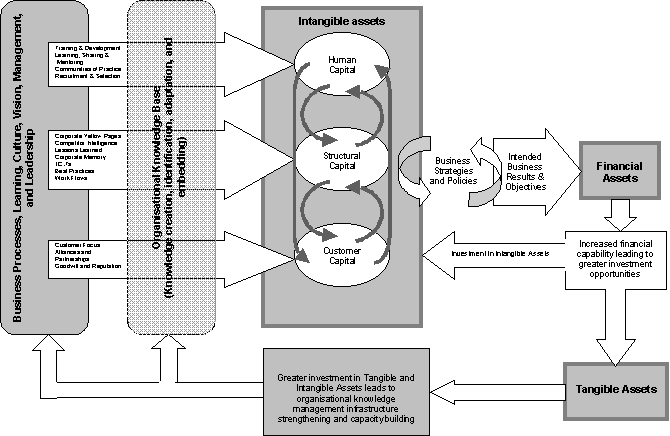
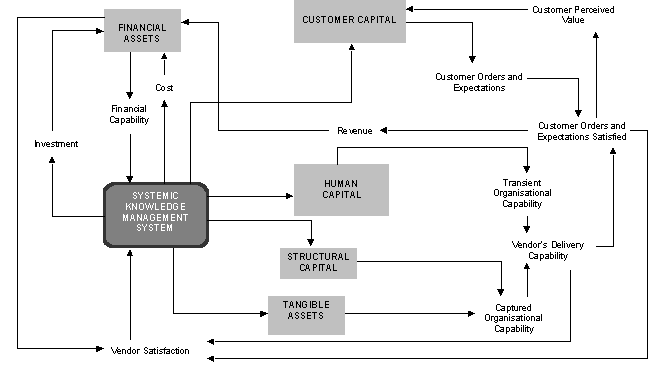
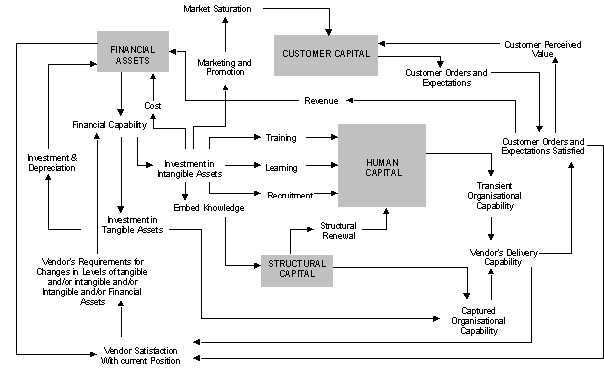
Systemic Knowledge Management: Developing a Model for Managing
Organisational Assets for Strategic and Sustainable Competitive Advantage
Asad Kamran Ghalib, Royal Bank of Scotland, Manchester UK
ABSTRACT:
Intellectual capital and knowledge have been explored and pursued along
varied dimensions particularly from the early ‘90s, when the world saw a sudden
surge towards recognition of these resources as valuable, intangible assets.
However, knowledge and its management were still thought to be focused
primarily on artificial intelligence, databases and corporate intranets.
Lately, there has been a growing inclination towards both its
technological as well as the social connotations. This has led to the treatment
of the management of knowledge in a more ‘systemic’ fashion, rather than
considering it an isolated and discrete constituent of managing intangible
assets.
This paper explores the ‘systems’ concept and looks at the dynamic
interactions between all types of organisational assets: financial, tangible,
and intangible. Following the definition of systems, the concepts of their
wholeness and synergetic effects are discussed. Major types and classes of
systems are then identified, followed by a detailed discussion of the key
characteristics of the ‘social-systemic organisation’, as well as systems
thinking and practice in organisations.
Knowledge and its management being the focus of this study, a model
based on systems thinking and practice in organisations is developed and
elucidated. This model endeavours to include the social as well as
technological implications along with the subsystems, parts, and elements of
the entire organisational system which have to be considered in an attempt to
effectively manage knowledge in a more holistic manner, rather than treating it
as a secluded and disconnected function. Prior to conclusion, the model is
further exemplified by a practical illustration using an organisation that
employs such a model to manage its intangible assets.
1. Introduction
During the late 1980s and particularly in the 1990s, the entire business environment underwent radical changes resulting in sweeping effects on the way organizations operated globally. This was fuelled primarily by increasing customer knowledge and market awareness, thereby leading to an increased demand for high quality, value-for-money goods and services. Resultantly, businesses engaged in relentless and intense competition on a global scale. This was augmented by rapid technological advancements, increased customer focus, aggressive marketing strategies, and global expansion.
Organisations underwent major transformation in terms of re-engineering production and design methods, as well as restructuring and ‘flattening’ management styles by eliminating layers of hierarchies and encouraging decentralization and emphasizing greater teamwork.
Furthered by employees becoming progressively skilled and being able to work better than their immediate bosses, the socio-economic environment in organisations became increasingly turbulent, thus resulting in greater de-centralized control. The mechanistic concept of management, argues Ackoff (1999A:23), changed focus from ‘command and control’ to managing employee interactions, and not their actions alone; as well as to administer the interactions of the unit they manage with other internal and external organisational units and organisations.
As the marketplace grew, it
became inevitably competitive. This, in turn gave rise to the unprecedented
value of the wealth of information and knowledge. During these past 50 years,
argues De Geus (1999:32), the world of business shifted from one dominated by
capital to one dominated by knowledge: thus leading to the rise of asset-poor, brain-rich
companies. He argues that the critical production factor, then shifted from
capital to people. Knowledge, according to him, has eventually ‘displaced
capital as the scarce production factor – the key to corporate survival and
success’.
Economists have attributed this transformation to the shift in the global economic infrastructure: from a labour-intensive and manufacturing-based economy, to one that is knowledge-driven, from the industrial era to the information and knowledge age. The result: a global marketplace in which information, knowledge, and services act as the key drivers for economic viability and growth. The instant dissemination of these vital entities has been made possible by rapid advancements in the communications and information technologies.
2. The
Definition And Nature Of Systems
The concept of systems dates back to the days of Aristotle and Plato. Ackoff even boldly claimed as far back as 1974 that we are living in ‘the Systems Age’, while Bertalanffy wrote in 1968 that the systems theory ‘heralds a new world-view of considerable impact’ (Ackoff, 1974, and Bertalanffy, 1968, cited by Checkland, 2000)
Systems have been described by various authors in an assortment of contexts. In an earlier essay on systems, Ackoff and Emery (1972), define a system as a ‘set of interrelated elements, each of which is related directly or indirectly to every other element, and no subset of which is unrelated to any other subset’. They deduce from the above, two points that are core to the definition:
(a) A system is an entity composed of at least two elements, and a relation that holds between each of its elements and at least one other element in the set.
(b) The elements form a completely connected set, which is not decomposable into unrelated sets.
From the second point we can infer that although a system may itself be part of a larger system, it cannot be decomposed into independent subsystems: each subsystem, part, and/or element in not independent of one another but they all form a set that is bonded by the interrelatedness of the parts of the system.
In light of the above, we can arrive at a summarized and simplified definition of a system:
‘A system is a whole, that
consists of necessary but insufficient, interrelated parts or subsets having
one or more defining properties or functions, and which cannot be sub-divided
further into autonomous subsets, parts, or elements without loss of its
defining function’
2.2. ‘Wholeness’ And Systems
The concept of wholeness plays a pivotal role in systems thinking. While defining systems, when we talk about the interrelated parts of a system that comprise elements which cannot be decomposed into separate unrelated sets, it becomes evident that systems in themselves are actually ‘wholes’ and have to be viewed as such. Failing this, if we deem systems to be otherwise, the interrelatedness between the parts fails to hold true, which renders it void for such entities to be considered as systems.
Fuenmayor (1991:229) refers to this as a ‘pragmatically intended systems approach’ to systems thinking and argues that ‘in such a context the intuition of wholeness means that changes impinging upon the parts could have an overall affect very different from that which they have on the parts by themselves.
Plato, in the fourth century BC expressed
this notion as: ‘You ought not to cure the eyes without the head, or the head
without the body, so neither ought you to attempt to cure the body without the
soul; and this is the reason why the cure of many diseases is unknown to the
physicians of Hellas, because they are ignorant of the whole, which
ought to be studied also; for the part can never be well unless the whole
is well’ (Plato, 1954:13, cited by Fuenmayor, 1991:229).
Smuts, in 1926 (cited by Checkland, 2000) claims that ‘Holism is the inner driving force behind (evolutionary) progress: ‘every organism, every plant or animal, is a whole with a certain internal organisation and a measure of self-direction. Not only are plants and animals wholes but in a certain limited sense the natural collocations of matter in the universe are wholes; atoms, molecules and chemical compounds are limited wholes…A whole is a synthesis or unity of parts, so close that it affects the activities and interactions of those parts….The parts are not lost or destroyed in the new structure…their independent functions and activities are grouped, related, correlated and unified in the structural whole’.
Peter Senge in his groundbreaking book, ‘The Fifth Discipline’, asserts that in order to solve problems, we tend to break them apart into smaller fragments, while this may make complex tasks and subjects more manageable, we pay an enormous, hidden price: ‘we lose our intrinsic sense of connection to the larger whole’.
The whole or the system, according to him, is ‘bound by invisible fabrics of interrelated actions, and can be understood only by contemplating the whole and not just any individual part of the pattern’.
Arguing the case of the vitality of looking at problems systemically, Senge (1990:127) presents the metaphor of having the ability of the ‘art of seeing the forest and the trees’, the ability to ‘step back’ far enough from the details to ‘see the forest for the trees’. ‘But unfortunately’, he says, ‘for most of us when we step back, we simply see just a lot of trees. We pick our favourite one or two and focus our attention and efforts for the change of just those’. While we may think that, we have been able to solve the problem, by ‘curing’ just that single part, the actual reality may be different, as, going back to Plato: ‘the part can never be well unless the whole is well.’
2.3. The Synergetic Effect Of Systems
When the parts of a system perform their intended functions, they produce a powerful and multiplicative effect that is greater than the simple sum of the functions of the parts taken individually. The resulting synergy makes us understand why we have to consider systems in a more holistic fashion.
Laszlo (1972:36) has especially pointed out the synergetic effect that the idea of wholeness brings about in systems thinking: ‘the concept of wholeness defines the character of the system as such, in contrast to the character of its parts in isolation. A whole possesses such characteristics that are not possessed by its parts singly; the whole is therefore, other than the simple sum of its parts.
In other words, if we sum up (Vs ) individual parts va, vb, vc, …vn of a system S, then the sum of the constituents, ∑ will not be actually equal to the simple sum of these parts as shown below:
S [Vs ≠ ∑ (va + vb + vc + … vn)]
Instead, the effect produced by the synergetic whole will be greater than the mere summation of the individual parts.
S [Vs > ∑ (va + vb + vc + … vn)]
3. Characteristics,
Types and Classification Of Systems
We will now have a detailed examination of the characteristics, and the conditions to be satisfied before any entity can be recognised as a system. Summarised below are such five stipulations that Ackoff (1999A:59), puts forth. He describes a ‘system’ as a whole consisting of two or more parts that satisfies the following five conditions:
¨
The ‘whole’ has
one or more defining properties or functions.
¨
Each part in the set can affect the behaviour
or properties of the whole.
¨
There is a
subset of parts that is sufficient in one or more environments for carrying out
the defining function of the whole; each of these parts is necessary but
insufficient for carrying out this defining function.
¨
The way that each
essential part of a system affects its behaviour or properties depends on (the
behaviour or properties of) at least one other essential part of the system.
¨
The effect of
any subset of essential parts on the system as a whole depends on the behaviour
of at least one other such subset.
Systems in general
can be classified in diverse terms such as those of size, location, functions,
and discipline e.t.c. Patching (1990) maintains that precise classification is
difficult ‘as certain types of systems overlap, depending very much on
individual interpretation and point of view’. Wilson, according to him,
proposes four major classes: natural, designed, social & cultural, and
human activity systems.
Alternatively, Boulding’s (1956) hierarchy of systems (Hatch, 1997 and Checkland, 2000) encompasses nine levels ranked in order of complexity: frameworks or structures, clockworks, control mechanisms, open (living) systems, genetic (lower organisms), animals, humans, social organisations or socio-cultural systems, and finally, transcendental.
Checkland (2000) draws attention
to another attempt regarding construction of a systems taxonomy: the Jordan’s
(1968) classification of systems. Jordan’s classification instigates from
perceptive deduction of three ‘organising principles’ that may enable us to
perceive a group of entities as ‘a system’. These principles are rate of change, purpose, and connectivity. Each of these principles
in turn, defines a pair of systems properties which are totally opposite to
each other. Rate of change leads to
the properties ‘structural’ (static) and ‘functional’ (dynamic); purpose leads to ‘purposive’ and
‘non-purposive’; and the connectivity
principle leads to such groupings that are either ‘densely connected’
(organismic) or ‘not densely connected’ (mechanistic or mechanical).
Originating from these three principles are eight ways of selecting one from each of the three pairs of properties, giving rise to eight ‘cells’ which are potential descriptions of groupings worthy of the name ‘system’, e.g. structural/purposive/mechanical, functional/non-purposive/organismic, etc. (Checkland, 2000).
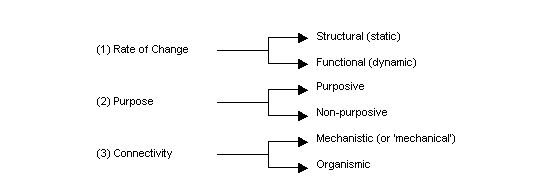

Figure 1: Dimension-based taxonomy of systems (after Jordan,
1968)
Ackoff (1999B) however contends on such classification that is based on the basis of one critical classifying variable: purpose.
According to this classification criterion, the parts of a system and the system as a whole are determined as to if they are purposeful or not. Based on this paradigm, he puts forth the following four different types of systems and models:
¨ Deterministic: such
systems that, as systems (as a whole), as well as their parts, have no purpose
of their own are classified as deterministic. They are generally mechanical in
nature; examples include automobiles, clocks and motors.
¨ Animated: those systems and models which are purposeful as a whole but their parts are not (taken individually). Living organisms, plants and animals, including humans are examples of this category of systems. A human being has a purpose of existence in its wholeness, taken together, but individual parts (organs) of the human body have no existence or purpose.
¨ Social: both the parts, considered separately, and the system as a whole have a purpose. Corporations, organisations and universities are examples of this type and model.
¨ Ecological: opposed to animated systems, ecological systems contain some parts which are purposeful taken individually, but viewed in their entirety and wholeness; have no purpose of their own. Nature, for instance, comprises interacting and purposeful parts such as mechanistic, social, and organismic systems, but it has no purpose of its own, taken individually as an entire, whole system.
Regardless of which method of classification we consider, what is actually most significant is how the individual perceives the system, and his purpose. Going back to Patching (1990), ‘classification depends primarily on individual interpretation and point of view’.
Given the limitation and the scope of this study, we will restrict our discussion exclusively to those systems in which the parts, considered independently, as well as their sum: the whole, have a purpose: social systems.
4. Systems
Thinking In Organisations
Prior to discussing the concept of systems
thinking in organisations, we will first look at what is meant by an
organisation in systems terms. An organisation, describes Gaus, (Selznick,
1948) is ‘the arrangement of personnel for facilitating the accomplishment of
some agreed purpose through the allocation of functions and responsibilities’.
These functions and responsibilities, which Gaus evokes, are accomplished by
employing three critical elements: procedures, processes, and people.
Procedures ‘enable the coordination required to achieve a coherent organisational identity or to ensure that services are consistent across units’ (Hatch 1997:32). The systematic application of such procedures (what) facilitates decision-making in order to execute work processes (how), by drawing on available resources: people (human resources), for instance.
These functions and responsibilities have to be allocated to personnel through some departments, divisions, or parts within the organisation, in order to facilitate the ‘accomplishment of some agreed purpose’ described by Gaus, or what Ackoff (1999A), calls the ‘defining function’ of the organisation.
In order to attain this defining function, the technical and managerial skills on hand have to be mobilized, which in turn require a pattern of coordination, a systematic ordering of positions and duties which defines a chain of command and makes possible the administrative integration of specialized functions (Selznick, 1948). Barnard (Selznick, 1948:301) proposes a more generalized, and a ‘system oriented’ definition of an organisation as being ‘a system of consciously coordinated activities or forces of two or more persons.
Systems thinking, on the other hand has its foundations in the field of system dynamics, originally founded by MIT professor Jay Forrester in 1956, as he recognized the need for a better way of testing new ideas about social systems, in the same way we can test ideas in engineering.
Aronson (1998) contends that the approach of systems thinking is fundamentally different from that of traditional forms of analysis. According to him, whereas the word ‘analysis’ means ‘to break into constituent parts’, systems thinking, in contrast, ‘focuses on how the thing being studied interacts with the other constituents of the system – a set of elements that interact to produce behaviour – of which it is a part.’ The fundamental concept of this approach makes it look at the picture in its wholeness, rather than considering each broken part as an independent, separate and isolated entity.
As organisations today become increasingly complex with several departments performing highly specialized and differentiated functions, the management, in an attempt to address problems that arise, not only fails to step back and look at the issues, in their entirety, but often makes poor decisions by considering each occurring problem as isolated and disintegrated from the other.
Senge (1990) describes systems thinking as a ‘conceptual framework, a body of knowledge and tools that has been developed to make the patterns clearer and to help us see how to change them effectively’.
‘Systemic thinking’ (Peters & Beishon, 1981:14), taken loosely,
looks at situations, topics, problems, etc., as a complex of interacting parts
which can be divided into specific systems and within these, subsystems, and if
necessary, into sub-subsystems, and so on. Once these various constituent
systems and sub-systems are identified, the relationships between these are
examined. These may be the flows of influences, materials, energy, other
resources, and the routes these adopt both among and within the system in a
given environment (ibid).
Although interaction between
the parts of a system has been emphasised throughout this section, as a key
element in recognition of a system as ‘systemic’, what has to be appreciated,
however, asserts Ackoff (1999A:19), is the quality of the interaction of
the parts and not just the mere interaction of the parts: ‘The performance
of a system depends more on how its parts interact than on how they act
independently of each other.’
High-quality organisational interaction between the parts, both within and outside the concerned organisation leads to such an organisational environment that is highly conducive to the systematic execution of business procedures and processes, which leads to the realisation of organisational objectives, the ‘defining function’ (Ackoff 1999A), or the ‘accomplishment of some agreed purpose’ (Selznick, 1948:301).
5. Social
Systems And The Social-Systemic Model Of Organisations
Social systems encompass social concerns such as organisations, corporations, universities, and societies. These systems may be part of larger social systems that comprise other social systems. Examples include large corporations and nations (Ackoff, 1999B).
Such systems are composed of parts that work together in individual capacities to achieve the ‘defining function’ of the system as whole. A manufacturing company may be composed of ‘parts’ such as the production, manufacturing, administration, human resources, operations, and finance departments. Each part (department) of the system (company) works individually and therefore serves the purpose of attaining the defining function.
The essential parts of the system can affect the performance of the system as a whole, but cannot do so autonomously and independently of all other essential parts working in the same system. While attempting to improve productivity or efficiency of an essential part, its effect on the system as a whole should not be overlooked. This will correspond to the degree and nature of the affect and behaviour the part in question has on the functioning of the system.
The parts, therefore taken and deemed to have a systemic influence on the functioning of the system as a whole to realize the defining function is core to social-systemic models of organisations.
5.1. The Social-Systemic Organisation – Key Characteristics
While tracing the events leading to social-systemic modelling in present-day organisations, Ackoff contemplates that after World War II, the corporate world saw a momentous transformation in the way organisations operated globally. Apart from the ‘hard elements’ such as production techniques and methods that contributed towards such change, the management’s social responsibility and work-related ethics emerged as major concerns.
Ackoff puts forth a model of the social
systemic organisation, by ascribing certain features to such types of set-ups.
These characteristics, suggested by him, have been summarised below.
5.1.1. Democratic
In Governing Nature
Such organisations are democratic in nature, since everyone affected by the decisions made has a say, and everyone in authority is accountable to others collectively. This means that no one has the ‘ultimate authority’ over others in the organisation.
5.1.2. Internal
Market Economy
The parts of the system (organisation) can sell or purchase both goods and services from any internal or external sources to meet their requirements. Higher-level intervention may be made use of, in order to compensate the affected part of the system in case of increased costs or lost income.
5.1.3. Multidimensional
Organisational Structure
The structure of the organisation has units of three different types located at each level of the organisation. These are defined by (a) their function (such units whose output is primarily consumed internally), (b) their output (external consumption of products and services), (c) their users (the markets: defined by the type and location of customers).
Interactive planning makes use of idealized re-design of the organisation and the closest approximation to that design. Such planning then passes through the following steps: selection of the requisite means, provision of the required resources, determining the steps to its implementation, and finally design of the monitoring, evaluation, and control of the initially designed plan.
5.1.5. Decision-Support
System
The social-systemic organisation contains a
decision support system that facilitates learning and adaptation by (a)
recording the expectations associated with each significance, (b) the
assumptions and information on which they are based, and (c) the process by
which the decision is arrived at and by whom it was reached.
The system subsequently monitors the implementation, original assumptions, and effects of every decision; rectifies where the decisions are incorrect or fall below desired expectations and retains in an easily accessible memory what has been learned. It also detects and identifies any changes that have occurred or are about to occur that necessitate adaptation by the organisation.
Asserting the influence and power of these key characteristics, Ackoff contends that any one or a subset of these changes can improve organisational performance significantly. Better still, when all are made together, there is powerful and multiplicative effect. This notion instigates the derivation of ‘systemic thinking’: the synergetic effect of the whole being greater than the simple sum of its parts.
6. Systemic
Knowledge Management
To begin with, an established model for
Knowledge Management will be discussed, on the basis of which a model of a ‘generic
dynamic systemic knowledge management system’ will be developed by
integrating the theoretical implications of systems,
systems thinking, the systemic organisation and system dynamics developed so far.
6.1. A Generic Model
for Knowledge Management
Knowledge management is a complex area, and one that spans boundaries – learning and development, information technology, and human resources. Having a model that describes the scope of activity that the knowledge management efforts cover can be a powerful monitor and communicate what an organisation’s approach encompasses (Collison and Parcell, 2001).
The model that will be employed here is one which Collison and Parcell present. This model attributes successful knowledge management to the interaction between three fundamental elements:
¨ People: knowledge roots from people; they form the basis for newly created knowledge. Without people, there will be no knowledge.
¨ Technology: a standardized and consistent reliable technological infrastructure that is able to support the appropriate tools on an organisation-wide scale.
¨ Processes: the capture, distillation, validation, transfer, and dissemination of knowledge throughout the organisation are completed by applying certain processes and procedures.
All three elements are not only necessary, but also complementary to one another, since knowledge management is such an area, where all three elements overlap as exhibited in Figure 2 below.
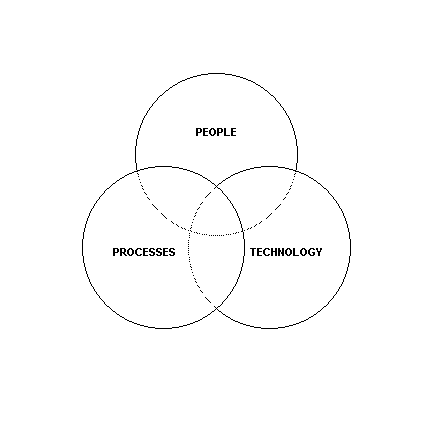

Figure 2: The Three Fundamental Elements Of Knowledge Management
[Adapted from Collison & Parcell (2001; pp. 18)]
This model is based on a framework that has been developed by the
authors in an attempt to demonstrate the activities that go into
managing knowledge. The knowledge life cycle, put forth and described by the
authors, explains how created and codified knowledge is actually made
practically useful: by embedding it into business processes and activities.
As illustrated below in Figure 3, the cycle passes through the following steps:
- Identification of knowledge created during the course of business activities.
- Capture of this newly created knowledge and its analysis, so as to elicit lessons learned and its codification.
- Validation and distillation of this codified knowledge into an approved set of guidelines, to form a permanent corporate knowledge asset.
- Embedding these guidelines into business processes, so that they reach the end users: the practitioners who actually need to use them.
- Application of the identified, analysed, validated, distilled, and codified knowledge to business processes and activities.

Figure 3: The
Activitie[A1]s
That Constitute Knowledge Management
[Adapted from Collison & Parcell (2001; pp. 19)]
It is worth noting that communities of practice play a central role in the framework. These can be loosely expressed as ‘such groups that learn’. They are not formed deliberately or in a structured manner. Instead, they arise out of certain individuals; drawn and attracted towards one another, and bound by a force that is ‘both social and professional’ (Stewart, 1998). They have common problems, and are in a constant and common pursuit of solutions. Communities of practice contribute in two major ways to the formation of human capital: knowledge transfer and innovation.
6.2. The Knowledge
Management Model And Organisational Learning
The model itself is centred on one fundamental process: Learning. The authors assert that the learning process spans over the entire knowledge management function.
In a learning organisation, every individual learns: employees stretch, grow, nurture, develop, and enhance their skills and capabilities to create and innovate. People learn to take risks while developing and experimenting new ideas. They are invited to learn what is going on at every level of the organisation. This promotes further learning through feedback as to how their individual contributions make a difference to the organisation as a whole and how they can further the shared cause.
Communication occupies a significant place in a learning organisation. Employees at all levels feel free to inquire about one another’s ideas, notions, concepts, and approaches. Mutual respect, trust, empathy, and a sense of belongingness play a significant role in building a learning organisation.
Peter Senge (1990;67) brings out the importance of making team-based, joint efforts in such organisations:
‘As the world becomes more interconnected and the business becomes more complex and dynamic, work must be become more ‘learningful’. It is no longer sufficient to have one person learning for the organisation, a Ford or a Sloan or a Watson. It is just not possible any longer to ‘figure it out’ from the top, and have everyone else following the orders of the ‘grand strategist’. The organisations that will truly excel in the future will be the organisations that discover how to tap people’s commitment and capacity to learn at all levels in an organisation’.
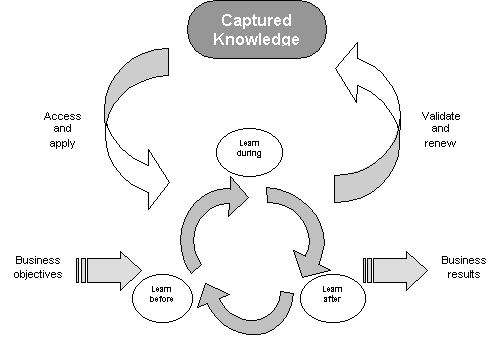
The model on knowledge management can be seen to carry the distinctive feature of ‘learning’ embedded in its architecture. It emphasises the need of learning at every opportunity: ‘before, during and after’ everything that is done. The authors contend that learning is one of the key elements of getting business results from business objectives.
Learning, according to them, takes place along three dimensions, which they explain as follows:
Learning Before: Before commencing a new task, team members can learn from work done on similar projects since it is likely that someone has already worked on it before. Corporate intranets, the Internet, search engines, corporate-wide yellow pages, etc., all prove to be good starting points for existing knowledge. It seems reasonable to learn from such instances before actually embarking on the venture.
Learning During: If, during the course of a project, team members occasionally keep on reflecting on what they have done so far, a lot of time, effort and resources may be saved by contemplating on the progress made and measuring it against the intended design. The authors suggest initiatives such as an ‘after-action review’ (AAR), short team meetings, and setting up communities of practice, etc.
Learning After: New projects tend to create a lot of new knowledge during the process of completion. Evaluating original intended design against current outcome and reality, during post-implementation reviews and audits, enables the team members to gauge how it could have been done better, and how the newly created knowledge could be codified for future use and reference.
Figure
4: The Collison And Parcell Model For Knowledge Management
[Adapted
from Collison & Parcell (2001; pp. 29)]
6.3. Knowledge
Capture During The Process
The codification of tacit knowledge converts it into the explicit form, thus leading to the formation of a permanent knowledge asset of the organisation. Captured knowledge requires some context and a collection of specific experiences that are ‘distilled’ to provide the content (Collison and Parcell, 2001). When team members ‘write down’ what experience they have gained while working on a particular project, they actually facilitate building up a knowledge repository, something that anyone in the organisation can always refer back to, should the need arise.
It is worth appreciating at this stage that the knowledge management model, in concurrence with the knowledge life cycle, the right tools, the appropriate software, and the requisite infrastructure are not all that is required for managing free-flowing knowledge in organisations. Perhaps one of the most vital and significant elements is the organisational culture.
Implementing the infrastructure is much simpler as compared to reengineering the entire organisational culture with a view to developing it in such a manner that is based on shared values, trust and empowerment, continuous learning, innovation, and improvement, in a no-blame environment. Without creating the right environment: the appropriate culture, ‘one which nurtures the right behaviour and fosters a supportive company culture’ (Collison and Parcell, 2001), all efforts to manage knowledge become futile, despite there being everything else that is necessary.
7. A
Generic Dynamic ‘Systemic Knowledge Management System’ (SKMS)
The preceding two sections of this section
have dealt with the development of generic business and knowledge
management models. These models will now be integrated into the theory of
systems thinking and systems dynamics, discussed in the foregoing section, to
develop such a model of managing knowledge that takes into account the systemic
facet of organisations.
7.1. Defining Systemic
Knowledge Management (SKM)
Smith (1998) defines systemic knowledge
management as ‘those processes, tools, and infrastructures by which an
organisation continuously improves, maintains and exploits all those elements
of its knowledge base (related to its financial, tangible, and intangible
assets) which the organisation believes are relevant to achieving its goals. It
includes the processes, tools, and the infrastructure by which these goals are
modified as the organisation’s base changes’.
An important aspect to which this definition
points, is the consideration of the financial, tangible, and intangible assets
of organisations, which have to be considered in an attempt to ‘improve,
maintain, and exploit’ the elements of which the knowledge base of
organisations is built up.
Smith (1998) asserts that despite the fact
that interest in addressing the potential of intangible assets has increased,
concern for, and the management of financial, tangible, and intangible assets
have become increasingly disconnected. He ascribes this to a sudden surge towards
increased specialisation, which he contends, roots from mounting competitive
pressures on both academics and varied internal and external experts.
In section 2, we saw that an organisation’s
knowledge base incorporates the data, information, intuition, insight,
perception, the knowledge it possesses (know how), the understanding (know
why), and wisdom that resides both within the organisation, as well as in the
outside parties that it transacts business with.
In an attempt to highlight the relationship that exists between financial, tangible, and intangible assets, Smith (1998) presents a Venn diagram with overlapping circles as illustrated in figure 5, whereby:
- Non-overlapping areas show asset potential;
- areas where elements do not overlap represent those areas where competitive opportunities can be partially captured;
- those areas in which all three elements overlap signify those opportunities that can be optimally addressed by the organisation.
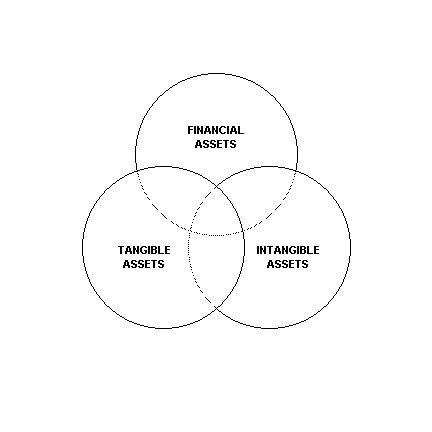

Figure 5: The
Financial, Tangible And Intangible System Of Organisations
[Adapted from Smith (1998)]
He further expands on the ‘intangible asset system’ as exhibited in Figure 5 above illustrating the relationship between the three types of intangible assets. Overlapping and non-overlapping areas of the circles indicate the corresponding degree of potential available for asset mobilization and stimulation in order to capture existing opportunities.
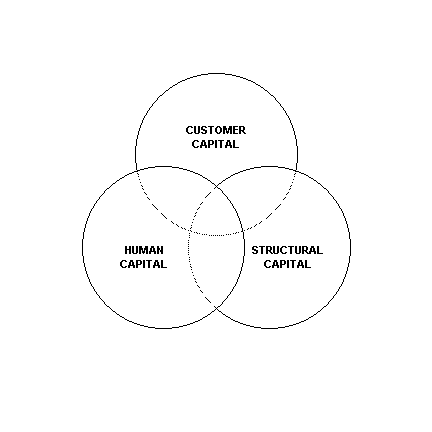

Figure 6: The
Customer, Human, And Structural Capital System Of Organisations
[Adapted from Smith (1998)]
Smith contends that ‘neither Intellectual Capital nor Knowledge Management is sensitive to the dynamic complex nature of the systems with which they deal’. What matters here, according to him, are the method in which the three elements identified and illustrated in both Figures 5 and 6 can move in relation to one another, along with the speed of change and their inter-relatedness. Without this understanding, he argues, organisations are forced to run their businesses as if they were a football team which could only see the scoreboard at the end of every quarter, and had to try to win the game with no feedback on the play by play.
7.2. Developing a
Model for Systemic Knowledge Management
Keeping in view system dynamics and systems thinking in organisations, a model has been developed that takes into account the systemic facet of the management of knowledge in organisations. The model, set out in figure 7, has been explained below.